
The Power of Dramatic Play

We can all agree that watching kids play pretend is oh-so-cute. Whether they’re acting as a veterinarian to their stuffed animals or hosting a tea party with some very classy imaginary friends, there’s nothing quite like seeing children get lost in their own little world of make-believe.
But there’s a reason that pretend play, otherwise known as dramatic play, is commonly used as a learning technique in early childhood education. While children are busy serving “tea” or giving very questionable medical advice for a broken paw, they’re also building all sorts of skills that support their development.
What is Dramatic Play—And Why Is It Important in Early Childhood?
Dramatic play is a type of play where children create and take on roles, then act out pretend scenarios. Sometimes, those are real-life roles, like a chef, firefighter, or teacher. Other times, it's a fantasy role, like a superhero, wizard, or dragon. It can also mean turning everyday objects into something completely different, like using a paper towel roll as a magic wand or a cardboard box as a racecar.
At its core, dramatic play gives children a chance to step outside their everyday world for a little while to explore new ideas, different perspectives, and endless possibilities. It’s especially valuable during the early childhood years, when children are still figuring out how the world around them works. Through play, they build language, social-emotional, cognitive, and executive-function skills. And for kids, it’s all just fun and games!
The Benefits of Dramatic Play
The benefits of dramatic play extend to all areas of development: social, emotional, physical, and cognitive.
Creativity and imagination. Have you ever watched a child engage in dramatic play and thought, “Where did they come up with that?” That’s a GOOD thing. Playing pretend is what encourages children to stretch their imaginations and think outside of the box.
Language and communication. Pretend play gives children a reason to talk, listen, ask questions, and use new words all in an authentic way. A child playing restaurant may take an order, describe the menu, or tell a customer that the only thing available today is spaghetti with rainbow sprinkles.
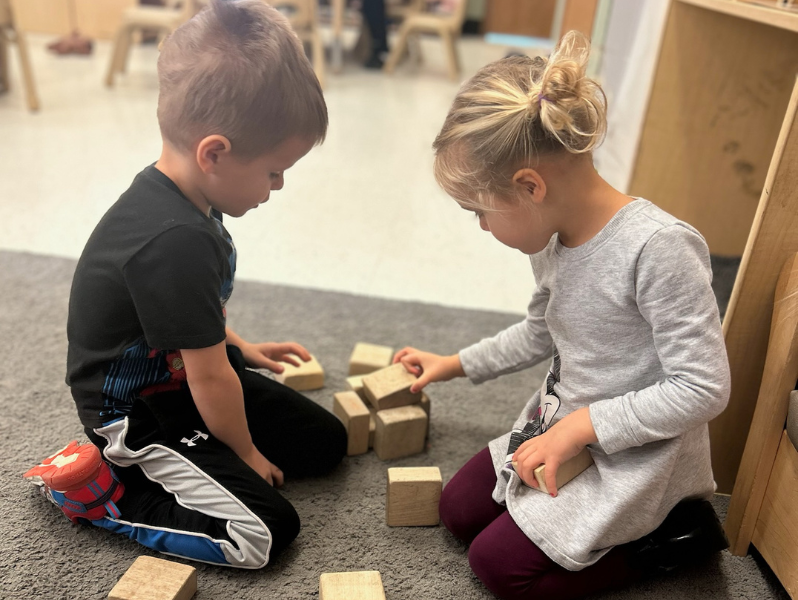
Social skills. Playing with others takes teamwork and patience. Children practice sharing materials, taking turns, negotiating roles, and working through disagreements when two people have their hearts set on being the veterinarian.
Problem-solving. What happens when the pretend store runs out of apples? Or when we’ve run out of diapers for the baby doll? Children get to think through challenges and come up with their own solutions...even if they are a little silly.
Early math and organization. Can math be fun? Dramatic play tells us that yes, it can! Sorting play food, counting pretend money, organizing a toy shelf, or setting the table all introduce early math concepts in a way that feels natural.
Self-regulation and focus. Dramatic play often asks children to follow a storyline, stay in a role, and work with others. A 3-year-old may move on from a role fairly quickly (completely normal) but, over time, that attention span grows, and children learn to stay engaged in play for longer stretches. They also get plenty of practice handling big feelings when someone else wants to be the veterinarian, or the game does not go quite as planned.
Dramatic Play at Jelly Bean Junction
At Jelly Bean Junction, we weave dramatic play into our curriculum for every age group. From infants and toddlers to preschoolers and school-age children, each classroom includes toys, materials, and spaces that invite children to use their imaginations.
During free play, children have opportunities to create their own games, take on new roles, and play alongside their peers. One day, they may be running a restaurant. The next, they might be caring for a room full of stuffed animals at a very busy veterinarian’s office.
“Our teachers do a great job jumping in to help the play evolve when needed,” shared Dianna Moore, Area Manager at Jelly Bean Junction. “They may join in with a question, offer a new idea, or help children work through a disagreement when two little ones have their hearts set on the same role.”
These moments give children the support they need to practice sharing, problem-solving, communicating, and managing big feelings—all in a setting that still feels fun.
Schedule a tour and explore our classrooms and see how we give children the space to imagine, explore, and learn through dramatic play.


Comments