
How Jelly Bean Junction Balances Learning and Play Through Play-Based Learning
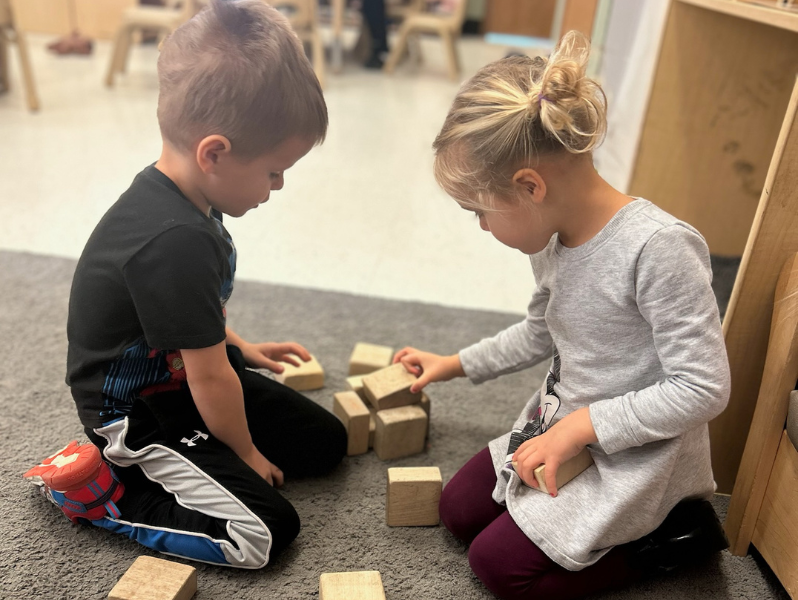
Picture a child carefully stacking blocks, watching them tumble, and trying again. What looks like simple play is actually early problem-solving, persistence, and cause-and-effect learning happening in real time. For young children, playing is not a break from learning. It is how learning happens.
When families begin evaluating childcare centers, the idea of “balancing learning and play” often comes up. Many people imagine a daily schedule split into neat sections, with structured learning at one time and free play at another. While routines are important, this kind of separation does not reflect how young children learn best.
What is Play-Based Learning?
Research shows that children develop stronger cognitive, social, and emotional skills when learning is woven into play throughout the day. Instead of stopping play to teach a lesson, high-quality early childhood programs use play as the foundation for learning. Children explore, experiment, communicate, and make sense of the world in ways that feel natural and engaging.
This approach is known as play-based learning, and it is a core part of how meaningful learning experiences are created during the early years.
Here’s what that might look like in practice at our learning centers:
An older infant banging their hand against a toy drum introduces them to cause and effect (when their hand hits the drum, it makes a sound).
A group of preschoolers acting out pretend scenarios gives them the opportunity to explain ideas, negotiate roles and tell stories. This not only helps them build language and vocabulary skills but also helps promote cooperative social interactions.
A toddler who is trying to build a tower made of blocks will need to use critical-thinking and problem-solving skills to construct a tower that doesn’t fall over.
Sometimes, these activities are 'child-led', meaning the play is completely unstructured, and the child gets to explore at their own pace. They choose the toys or materials they play with and control what they do with them with no direction from the teacher. This type of play is great for encouraging imaginative thinking and independence.
Other times, activities might be more guided, with a teacher asking questions or adding commentary during play to teach a specific lesson. For example, if a child is building a tower, the teacher might ask how they can make it taller to help foster critical thinking.
How Our Teachers Promote Play-Based Learning
For children to engage in play that supports key developmental skills, they need a classroom intentionally designed to invite exploration and spark imagination.
“Promoting curiosity and encouraging learning opportunities through play starts with the environment,” explains Diana Moore, Area Manager at Jelly Bean Junction. “That’s why we put a lot of thought into what materials we bring into our classrooms and how we arrange our spaces.”
It’s important to understand that play-based learning isn’t about choosing play over learning. It’s about using play in a way that creates valuable learning opportunities. We give the kids in our care the space to explore and engage with the world around them so that learning happens in a meaningful way and at a pace that works for them.
Schedule a tour to learn more about our learning centers and how we create an environment where children build confidence, curiosity, and a genuine love of learning.


Comments